
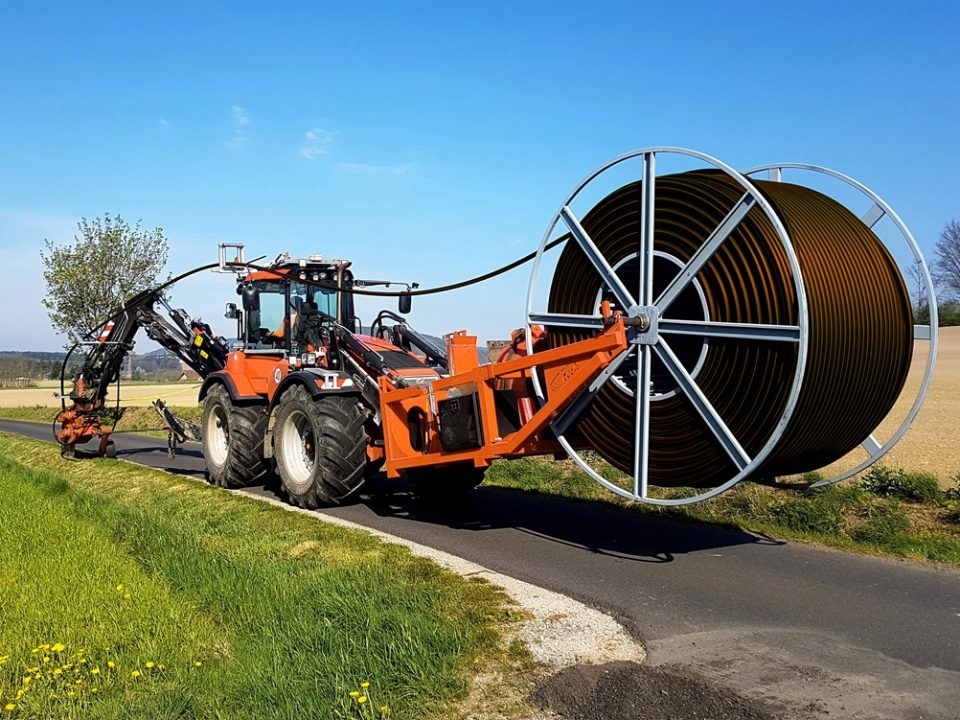
For utility companies, the goal is always to install infrastructure with the least amount of “reinstatement” cost. Reinstatement is the expensive process of repaving roads or re-turfing landscapes after a trench has been dug. By combining Horizontal Directional Drilling (HDD) with Mole Ploughing, contractors can offer a comprehensive “trenchless” package for almost any utility project.
The Efficiency of Mole Ploughing
While HDD is perfect for long-distance or deep crossings, Mole Ploughing is the ultimate solution for rural or “soft” landscape installations. A mole plough uses a powerful tractor or tracked vehicle to pull a vertical blade through the ground. Attached to the back of this blade is a “chute” that feeds the pipe or cable directly into the bottom of the slit as the machine moves forward.
The beauty of the mole plough is its speed. It can install hundreds of meters of cable or water pipe in a single day. Because the blade only creates a narrow slit, the ground “heals” almost immediately. In a field or a verge, the disturbance is so minimal that within a few days of rainfall, the installation path is virtually invisible. It is the most cost-effective and environmentally friendly way to install services up to 125mm in diameter.
Guided Boring for Complex Obstacles
When the path is blocked by a road, a driveway, or a protected tree root system, the team switches from the plough to a Guided Boring rig. This small-scale HDD rig can be set up in a space no larger than a parking spot.
The process remains the same: a pilot hole is drilled with steering capability to avoid existing services, followed by a reamer to enlarge the hole, and finally, the pullback of the pipe. This “hybrid” approach—ploughing the easy stretches and drilling under the obstacles—allows for incredibly fast deployment of fiber optic networks, water mains, and power cables.
Safety and “Service Striking” Prevention
The greatest risk in any underground work is “striking” an existing utility. Before any drill bit or plough blade enters the ground, a thorough Utility Mapping survey is conducted using Ground Penetrating Radar (GPR) and Signal Induction meters.
By mapping out the “underground map” of the site, operators can program the directional drill to weave through the existing infrastructure with surgical precision. This level of planning ensures that the project remains safe, avoids the massive fines associated with utility strikes, and maintains the integrity of the local infrastructure.
